Drums
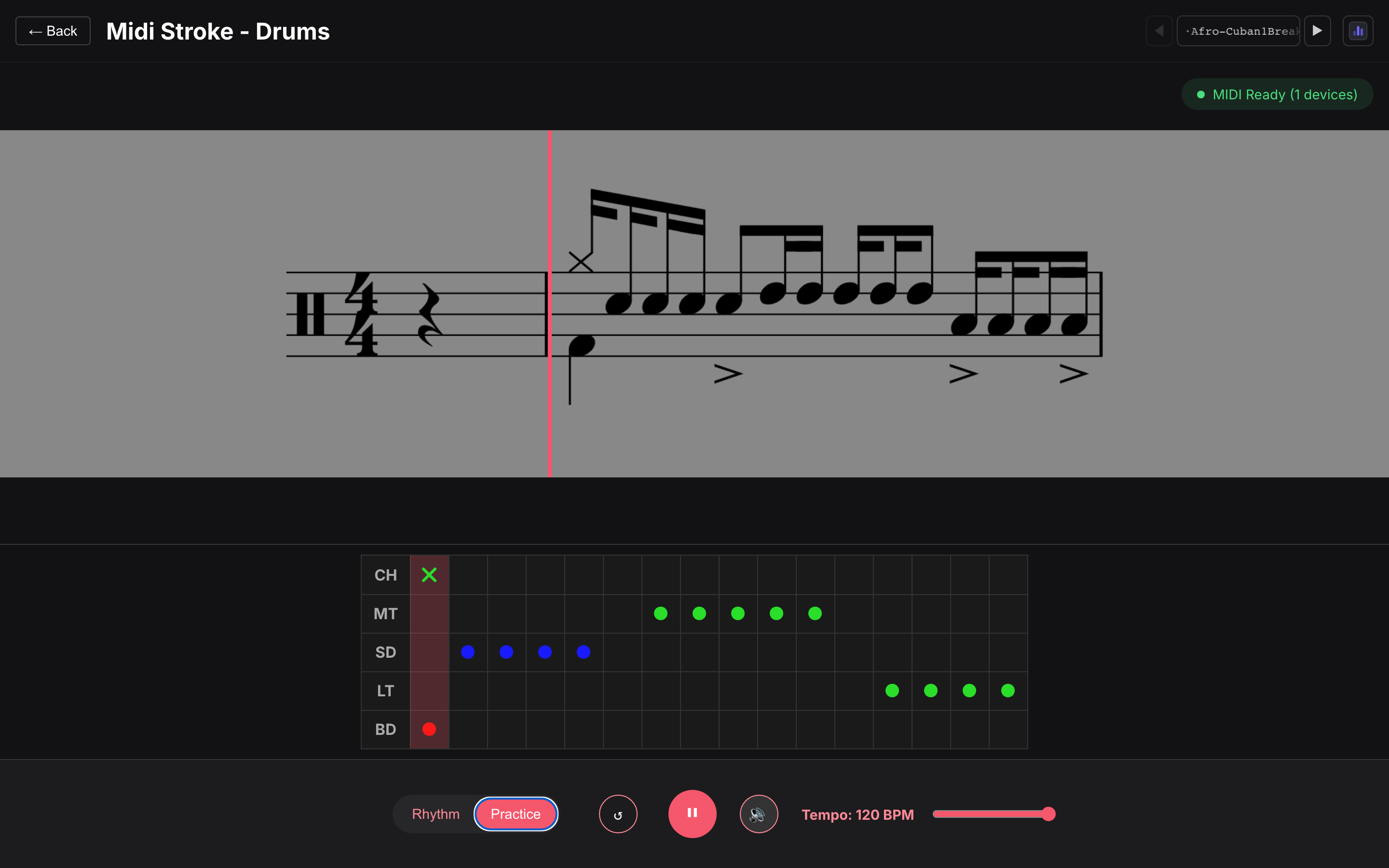
The drums app trains rhythm patterns — short loops of one or two measures on a percussion staff, built for the Yamaha FGDP-50 finger-drum pad (any GM-style pad controller works).
How it differs from piano
Section titled “How it differs from piano”- No hand selection, no calibration — pads are pads.
- Pads map to notation: drum notation encodes each instrument as a pitch and notehead shape (bass drum, snare, hi-hat, toms, cymbal). Incoming pad hits are matched back to the notated instrument automatically, and alternate pads for the same instrument (rimshot → snare, open → closed hi-hat) count as hits.
- Patterns loop: at the end of the pattern, playback wraps around with a short lead-in — keep grooving.
How it sounds
Section titled “How it sounds”Pads play a drum kit, not a piano: twelve voices covering kick, snare, rim, closed and open hi-hat, ride and crash, three toms, clap, cowbell and tambourine. They respond to how hard you hit, a closed hi-hat chokes the open one the way the pedal does, and alternate pads for the same instrument make the same sound.
The kit is synthesized rather than sampled, so there is nothing to download and it works offline — including in the desktop app, where sampled instruments need the network on first use.
The step-sequencer grid
Section titled “The step-sequencer grid”Below the staff, the pattern is also shown as a grid: one row per instrument, one column per subdivision (16 columns for sixteenth feels, 12 for triplet/12-8 feels), with the playhead sweeping column by column. Same music, two notations — read the staff, verify with the grid.
Pattern generator
Section titled “Pattern generator”The song picker’s 🎛 Pattern generator entry writes patterns for you. Drums have no scales, so what you choose is a kit and a density: a 16-step sequencer where you pick the voices and how many times each should hit in the bar.
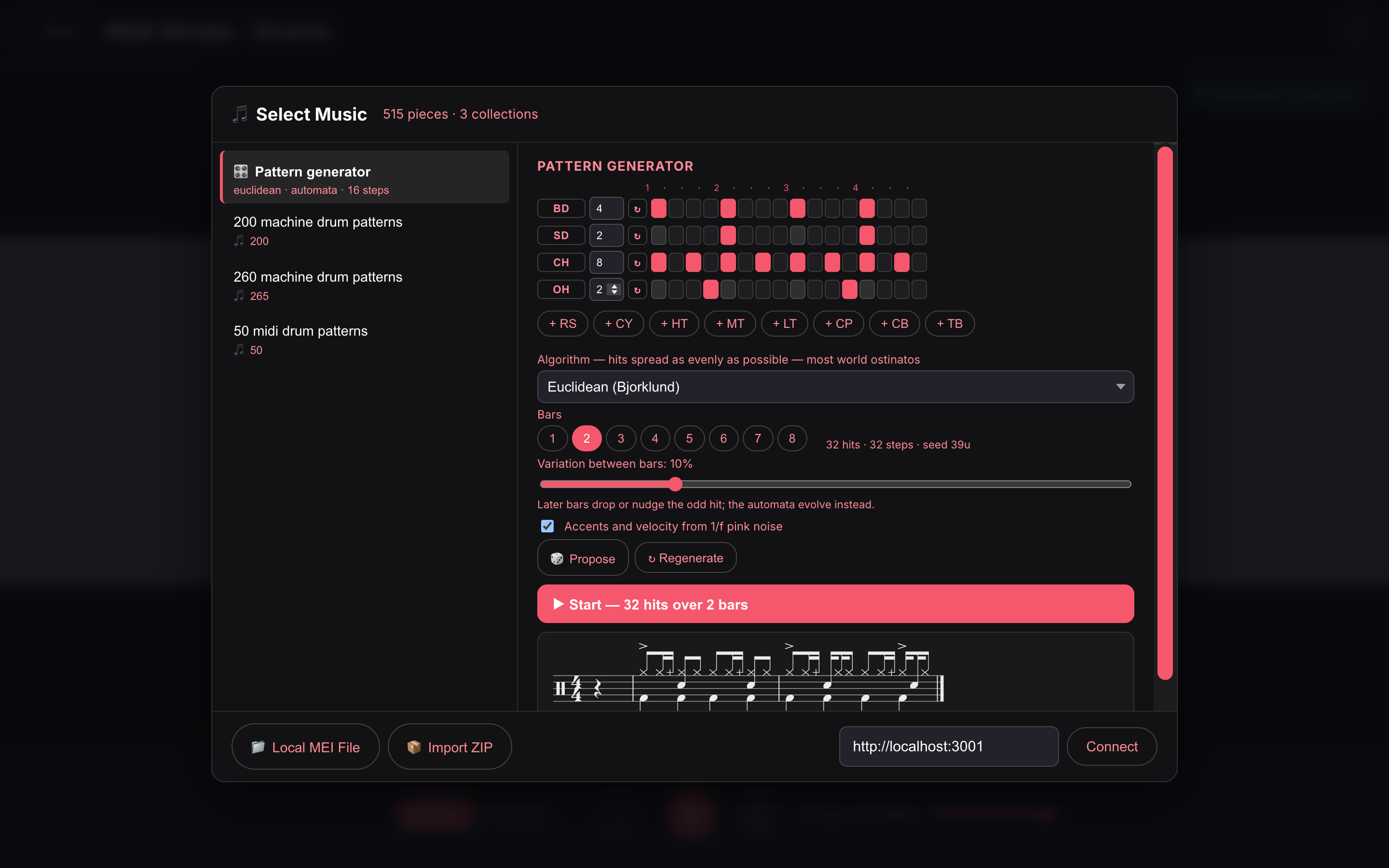
Set the numbers by hand, or hit 🎲 Propose to roll playable ones for the kit you assembled. Every cell stays editable — click any square to add or remove a hit, and the counter follows.
The algorithms
Section titled “The algorithms”Pure randomness sounds like noise, because rhythm needs metric hierarchy and anchor points. Each engine below answers the same question — given this many hits, which of the 16 steps?
| Algorithm | What it does |
|---|---|
| Euclidean (Bjorklund) | spreads the hits as evenly as possible — the distribution behind most world ostinatos. E(5,8) is the Cuban cinquillo, E(4,16) is four-on-the-floor, E(8,16) straight eighths |
| Metric-weighted Bernoulli | samples against the hierarchy of the bar: downbeat, backbeats, half-bar, eighth offbeats, then sixteenth ghost notes |
| Shift register | the Turing-machine trick: a locked loop that starts mutating as you raise the variation |
| Markov chain | each step conditioned on the one before, with a separate matrix per step so it never loses the downbeat |
| Cellular automata | Wolfram rules 30, 90 and 110 over the 16 cells, advancing one generation per bar — patterns that evolve instead of looping |
Each voice bends the hierarchy toward its own job, so a Euclidean snare lands on 2 and 4 while the kick keeps the downbeat.
Variation and dynamics
Section titled “Variation and dynamics”- Variation between bars decides how much later bars drift: at 0% the pattern is an exact loop, and a few percent drops or nudges the odd hit, the way a drummer varies a groove. The automata evolve instead.
- Accents and velocity come from 1/f pink noise, so dynamics group across a phrase rather than flickering from hit to hit.
Patterns are engraved as real percussion notation — two layers, kick stems down, beamed per beat, accents marked — and play like any other piece, with the step grid reading them back:
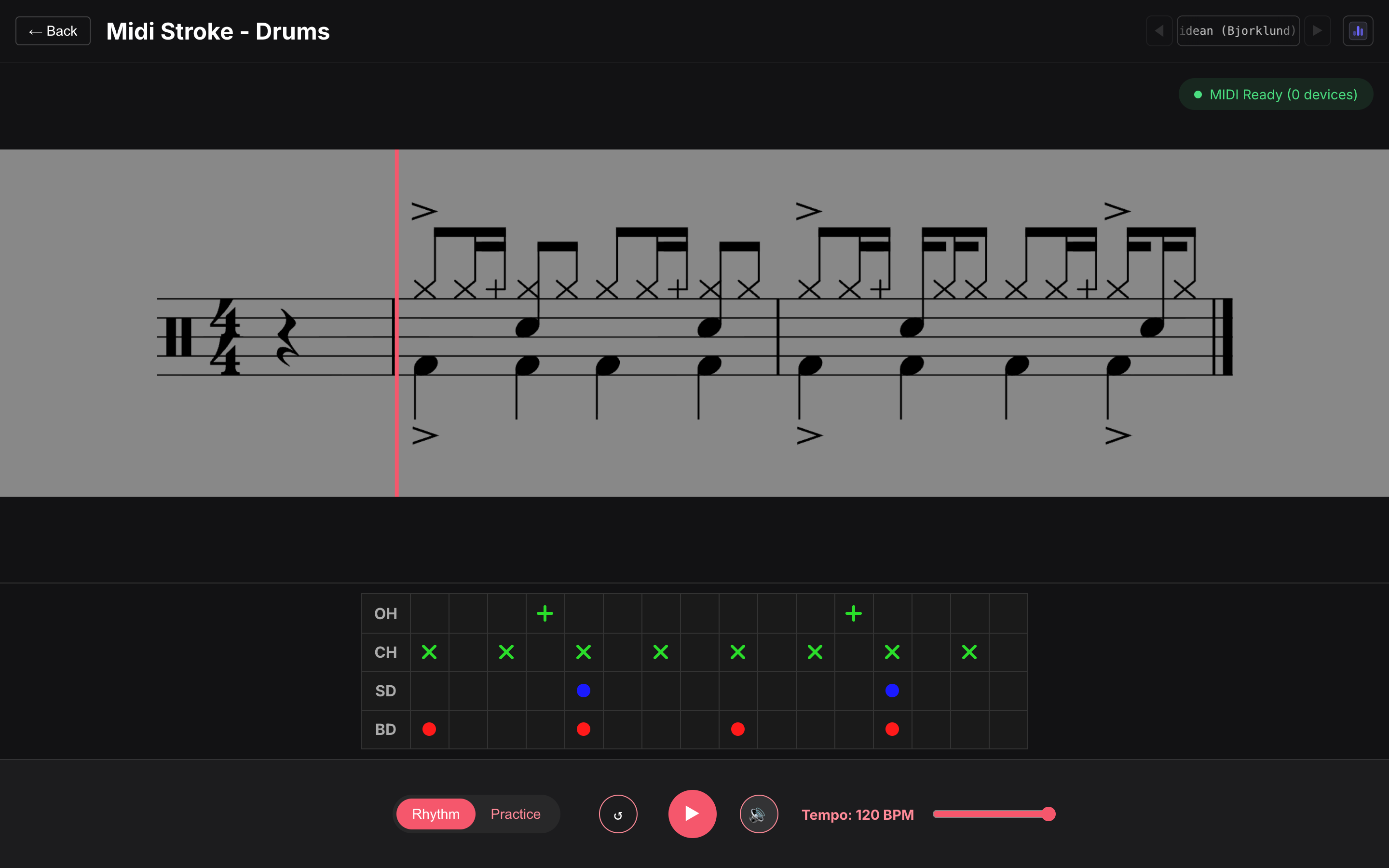
Every pattern has a seed, so the exercise you started is the one you come back to, and its stats accumulate like any other piece.