Games
The Games tab has short games about timing, and they need no instrument: a key, a tap on the screen or a drum pad will do. They’re for anyone, whether or not you play yet. Every level is real rhythm, and the songs are real pieces you can go on to play.
Slingshot
Section titled “Slingshot”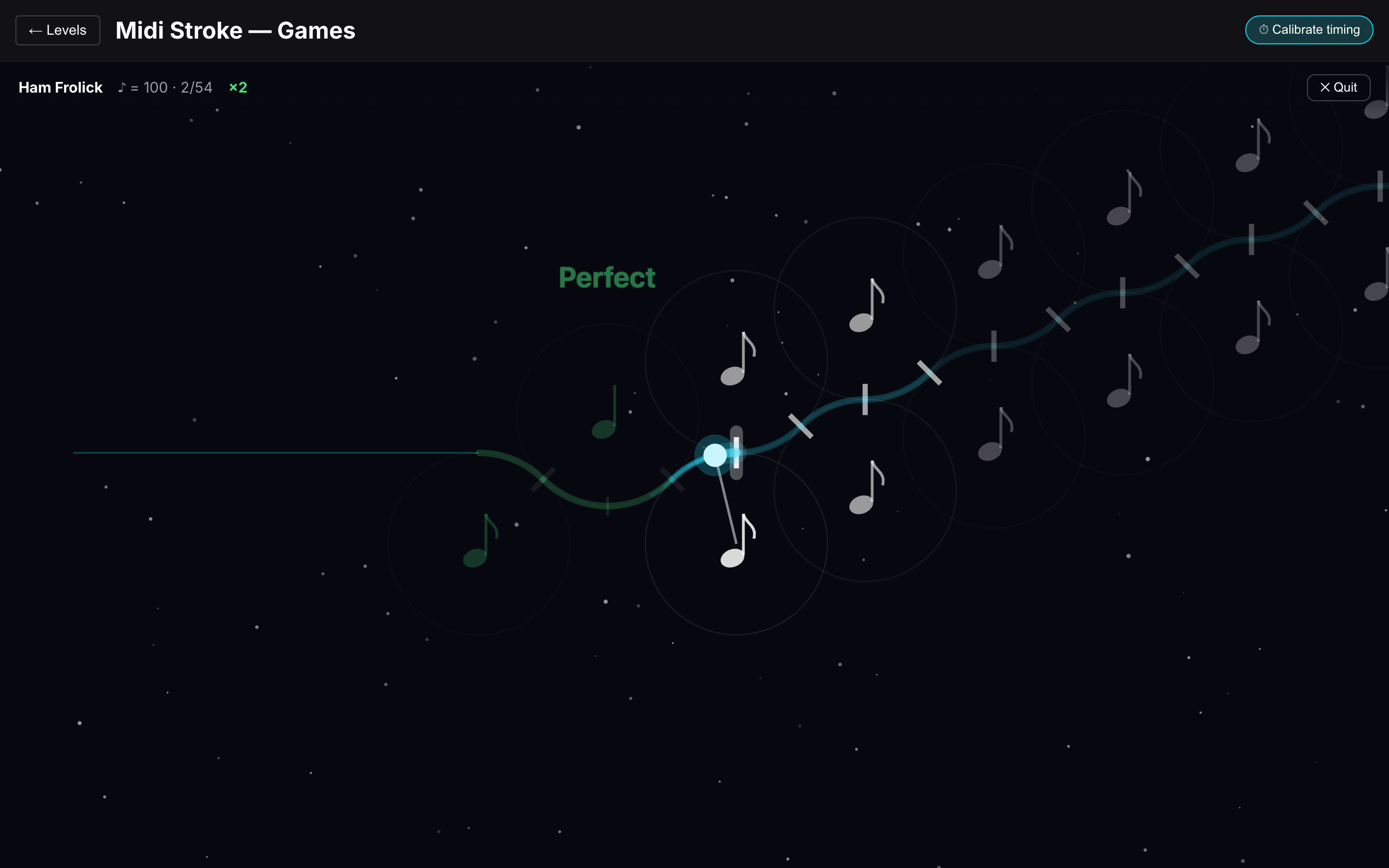
Hold to orbit, let go to fling. Press and hold space (or touch, or any MIDI key) as the probe reaches an anchor, and it whips around it, a quarter turn every beat. Let go at the white mark and it’s flung to the next anchor. How long you hold is the note: a half note is half a circle, a whole note a full one, and the note sounds for exactly as long as you hold it. Each anchor shows the note written out (an open whole or half note, a filled quarter, flagged eighths, dotted values). The part of the orbit still to go glows up to the mark where you let go, and shrinks as you hold, so you always know where you’re going and where to stop.
- Lessons teach one idea each: half notes, quarter notes, whole notes, a waltz in 3/4, eighth notes, dotted rhythms.
- Songs are the melodies of well-known tunes from the library: Twinkle Twinkle, Ode to Joy, Scarborough Fair and more. Finish one and Play it on the saxophone → opens it in the saxo app, to learn the notes as well as the rhythm.
- English folk tunes: God Save the King, Pop Goes the Weasel, Ham Frolick, Aire de l’Opéra françoise and Auld Lang Syne, also from the saxophone library. The clicks follow the metre: in 6/8 they count eighths, or dotted quarters when the tune is quick, and a tune that starts on an upbeat is counted in up to it.
- My pieces: add any MEI score with 📁 Add a piece, and its top line becomes a level. It’s kept on your device, and it also appears in the piano app under My pieces, where the button after a run takes you.
- Speed: Relaxed plays at three quarters of the tempo; As written plays at the piece’s own.
After each run you see how it went, with stars, accuracy, and a tip when you tend to let go early or rush. You also see the rhythm written out, every note coloured by how you played it.
Conductor
Section titled “Conductor”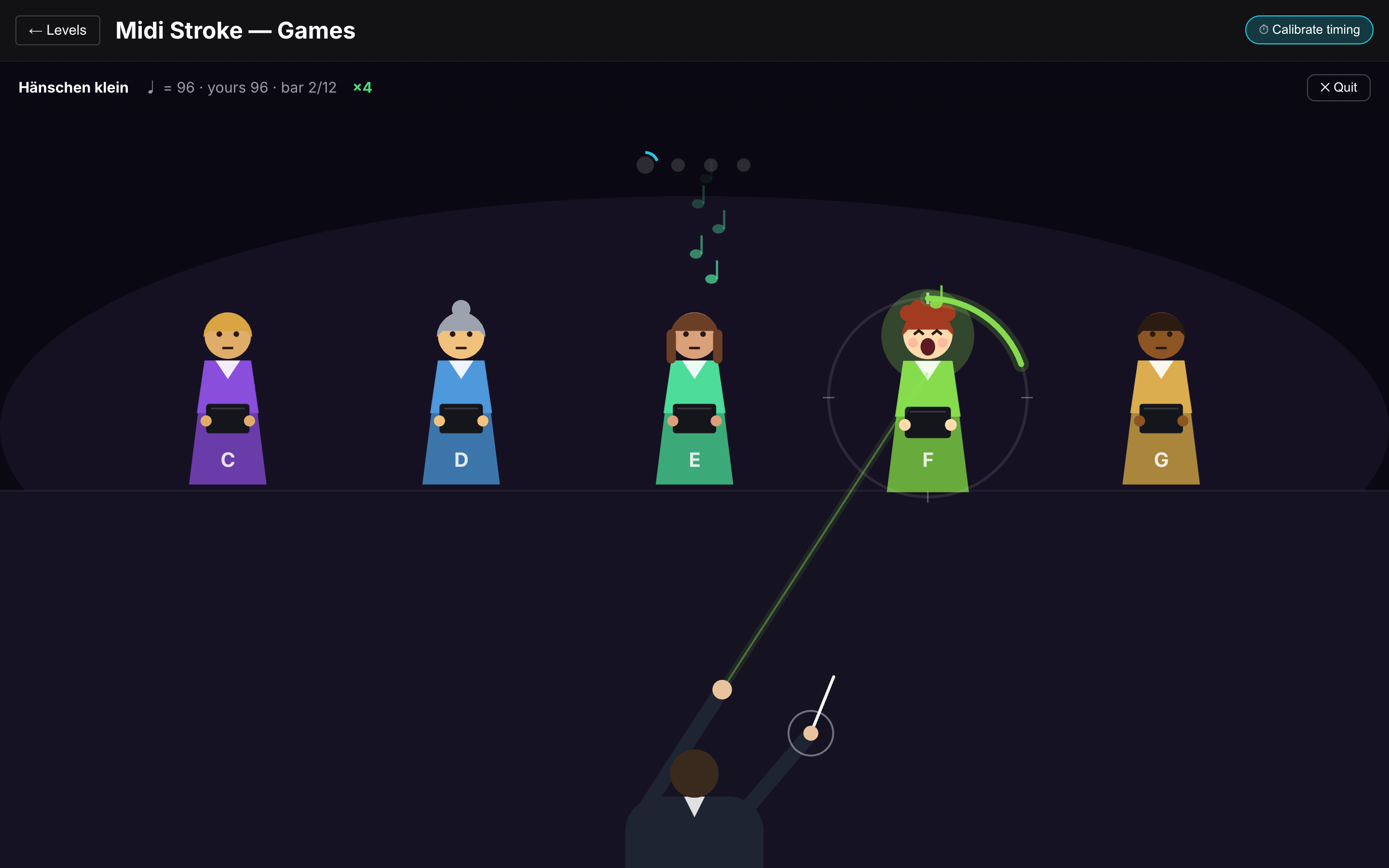
Conduct the choir, one beat at a time. Every note of the tune has its own singer, standing low to high like the keys of a piano. Hold space (or touch, or any MIDI key) for one beat: a ring fills around the singer as the beat goes by, and whoever has a note in that beat sings it. Let go as the ring closes and press again straight away for the next beat. A long note takes several holds, and the singer keeps singing through them; two quick notes can sing inside one hold.
The song follows you. Let go too soon and the singer is cut off, surprised. Hold on too long and they keep the note until they run out of breath, turning red. Wait before the next beat and the whole choir stops to wait for you. The conductor’s baton moves with your beats, and the display shows the tempo you’re conducting at against the piece’s.
- Lessons are the Slingshot’s rhythms, each given a tune, from three singers to eight, with a piano playing the chords.
- Folk songs from the piano library: Hänschen klein, Summ, summ, summ, Kuckuck and more. The choir sings the tune while the piano plays the left hand. Play it on the piano → takes you to the piece.
- English folk tunes, sung a cappella: God Save the King, Auld Lang Syne, The Drunken Sailor, Pop Goes the Weasel, Yankee Doodle, Camptown Races, Ham Frolick, The British Grenadiers, Ronda and Aire de l’Opéra françoise. The quick notes are the choir’s to sing: you still hold one beat at a time. The slow 6/8 tunes are conducted in six, one hold an eighth, and a tune that starts on an upbeat begins with a hold that has the upbeat in its second half.
- My pieces work here too.
- After a run, a chart shows every beat as you conducted it: taller where you stretched the song, lower where you hurried it. You also see how much longer or shorter the song came out, and the tune written out, each note coloured by how its beats went.
Rhythm echo
Section titled “Rhythm echo”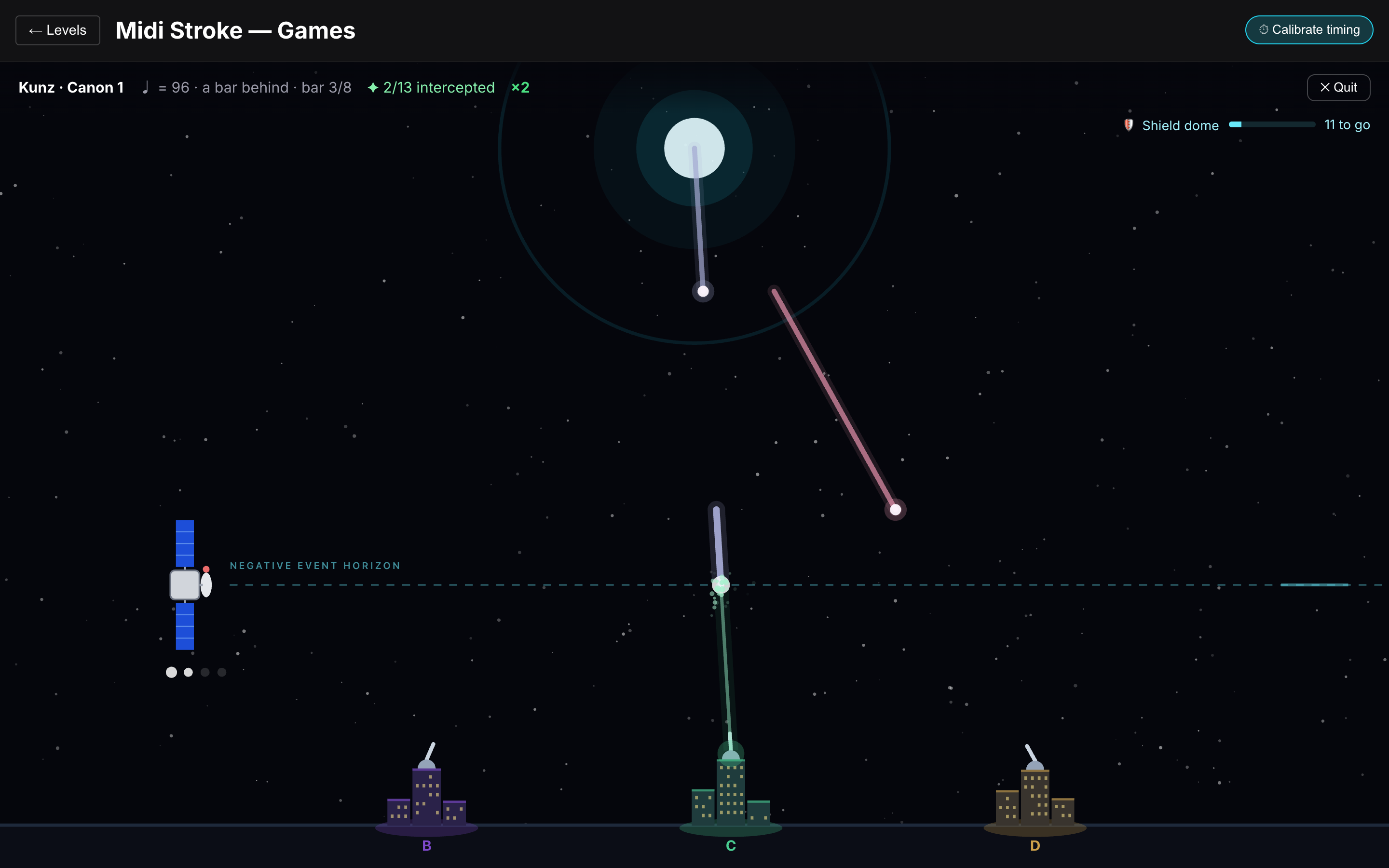
Sing the second voice of a canon by defending the cities from it: a musical Missile Command, with a good ending. A star sings a line, and each of its notes falls as a bolt of plasma on the city of its pitch, one city for every note of your voice, low on the left. A satellite watches a line across the sky, the negative event horizon, and every bolt crosses it just as your voice (a bar or two behind) should sing that note. Hold space (or touch, or any MIDI key) as it crosses and let go as its tail does: the city’s turret fires at it, and you hear your note for as long as you hold. Defend them all and the two voices together are the canon.
- Let go too soon, or never fire, and the rest of the plasma falls on the city: flames rise from it.
- Hold on too long and the turret overheats: flames rise from the turret.
- The shield dome charges as you go, and the last bolts are counted down. When your part is done the dome goes up, and the hollow bolts, the star’s last notes that your voice doesn’t answer, burst harmlessly on it. Then the fires go out, the lights come on, and there are fireworks.
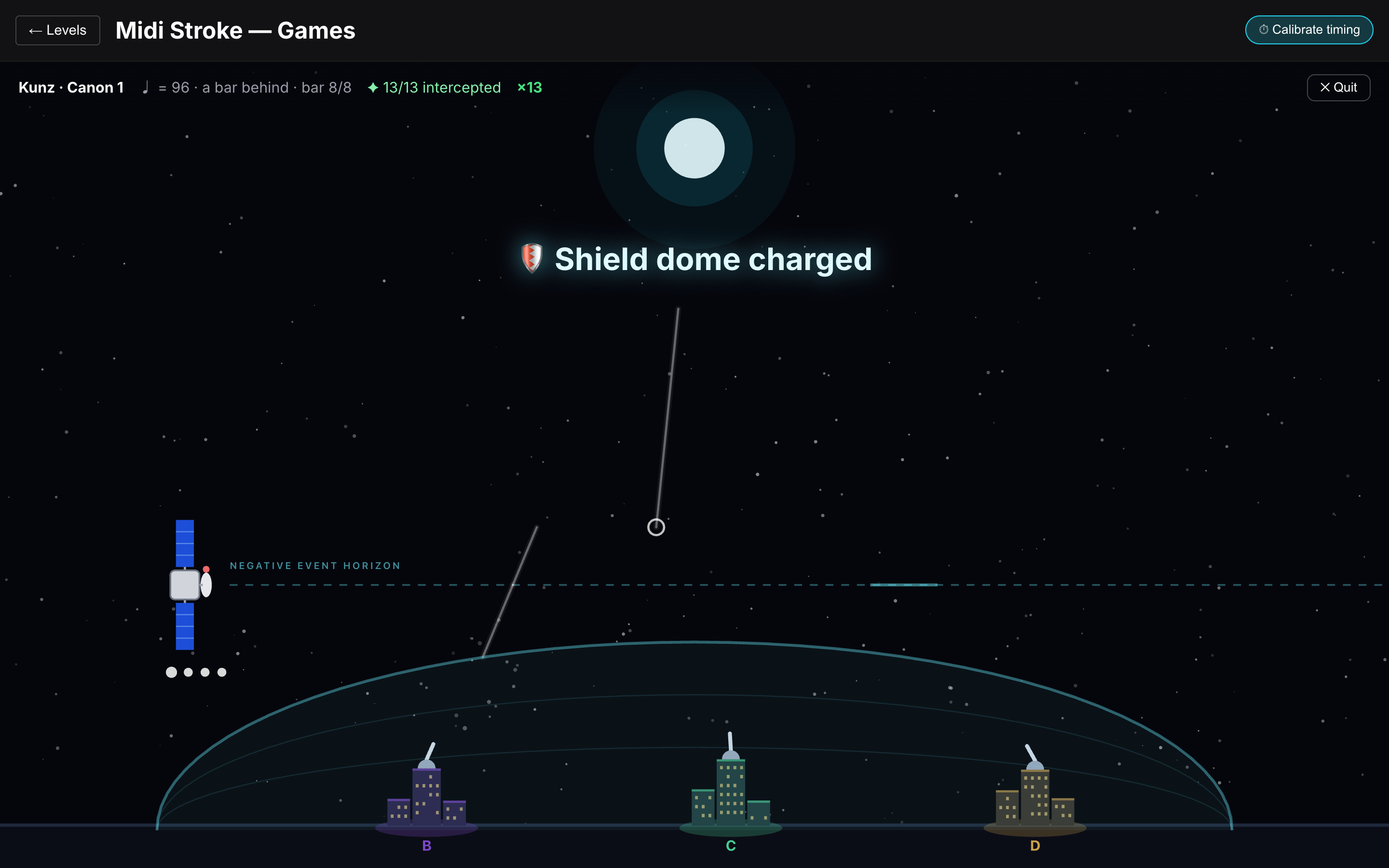
The results show what happened to every bolt, bar by bar: a green burst when it was intercepted, flames on a house when it reached its city, flames on a turret when it overheated.
- Lessons are short canons, one idea each: long notes, quarters, rests, Frère Jacques as a round, eighths, dotted rhythms, a waltz, and finally two bars behind.
- The Kunz canons (Konrad Max Kunz, 200 short canons, Op. 14) are real two-voice pieces from the piano library. Afterwards, Play both voices on the piano →. More are on the way.
- My pieces: add a two-voice canon of your own, and the voice that follows is yours.
Groove Builder
Section titled “Groove Builder”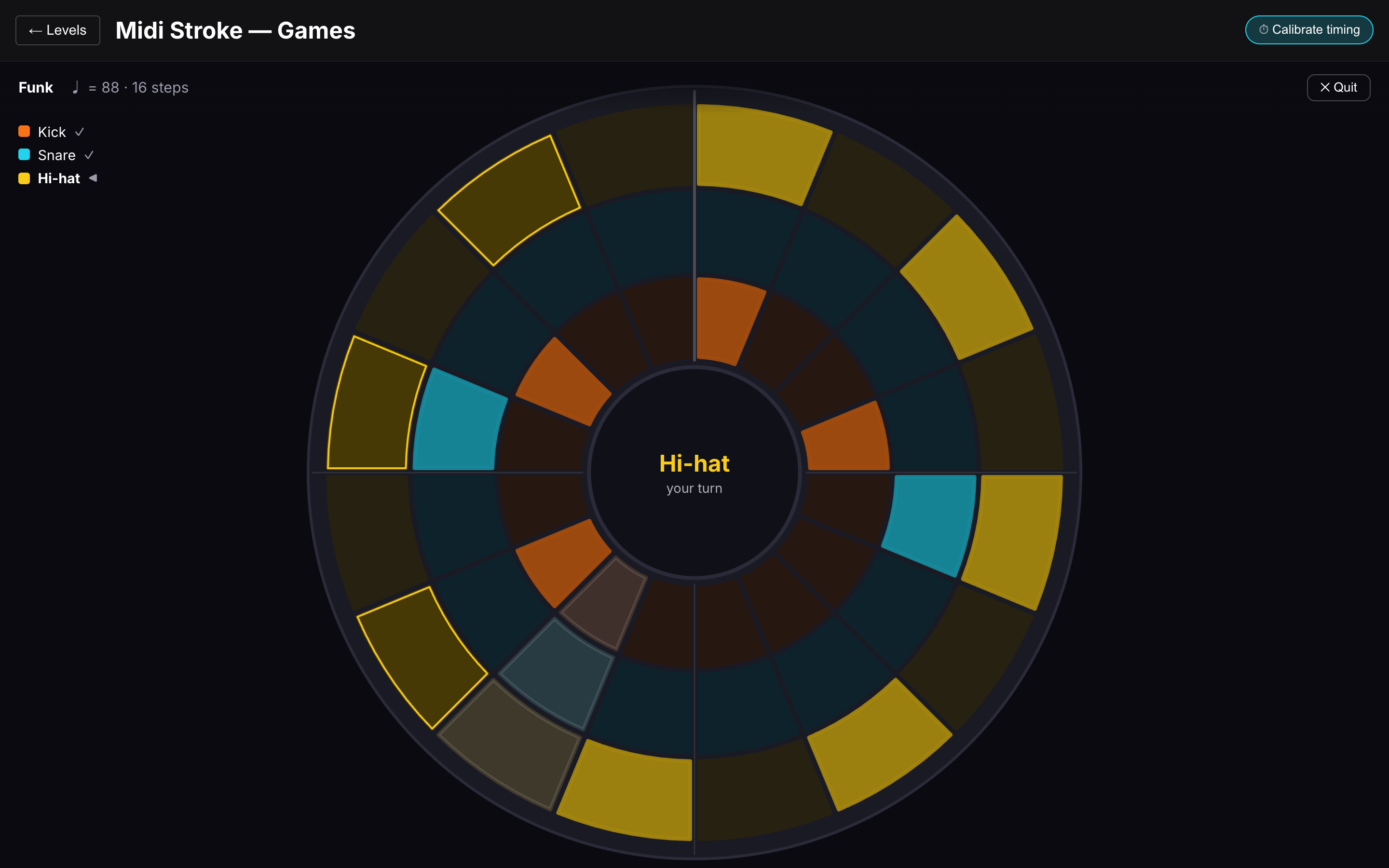
Build a drum groove one part at a time, like a looper. The groove is a wheel of pads, like a game of Simon: a ring for each part, and a pad for every step of the bar. A bar is counted in, then you play the kick once round, on the outlined pads, with space, a touch, or any MIDI key or pad. From then on the kick plays exactly as you played it while you add the snare, then the hi-hat, and so on. After the last part, the whole groove plays twice, and you hear what you built.
Every hit lands on a step, like on a drum machine, and what you play is what you get. A hit on the wrong step stays wrong for the rest of the song, and a missed one stays missing. The step playing lights up its column of pads as the groove goes round.
- Grooves come from the drum library, 24 of them, easiest first: ska, rock, disco, twist, pop, rhythm & blues, reggae, funk, bossa nova, Afro-Cuban, cha-cha, a shuffle, swing and a slow blues in 12/8, a triplet funk, and a six-part samba.
- After a run, the groove is shown as a step sequencer, the same grid as the drums app, with every hit on its step, every wrong one, and every one missing. Play it on the drums → opens the beat in the drums app.
Sounds
Section titled “Sounds”Each game has its own voice. The Slingshot’s notes are made from NASA space recordings, through Nasa Space Pad. The Conductor’s choir sings with The Spellsinger, and Rhythm echo’s star and turrets with Space Voices; its plasma lands with the meteoroid strike. The Groove Builder’s drum kit is cut from sounds recorded on Mars: the Perseverance rover’s laser zapping rocks, its wheels, its MOXIE machine, and a meteoroid strike heard by InSight.
Timing calibration
Section titled “Timing calibration”Every device takes a moment to play a sound and to notice a key. Choose ⏱ Calibrate timing once and tap along to eight clicks. The games then take that moment off, so a hit on the beat counts as on the beat.